

How Many States In A Two Bit Register
A shift annals is a blazon of digital excursion using a cascade of flip-flops where the output of 1 flip-flop is connected to the input of the next. They share a single clock signal, which causes the information stored in the system to shift from one location to the next. By connecting the concluding flip-flop back to the first, the data can bike within the shifters for extended periods, and in this form they were used every bit a class of computer memory. In this role they are very like to the earlier delay-line memory systems and were widely used in the belatedly 1960s and early 1970s to replace that form of memory.
In most cases, several parallel shift registers would be used to build a larger retentivity pool known every bit a "bit array". Data was stored into the array and read back out in parallel, ofttimes every bit a computer word, while each fleck was stored serially in the shift registers. At that place is an inherent trade-off in the design of scrap arrays; putting more flip-flops in a row allows a single shifter to store more bits, but requires more clock cycles to button the data through all of the shifters before the data can exist read back out again.
Shift registers tin have both parallel and serial inputs and outputs. These are often configured as "serial-in, parallel-out" (SIPO) or as "parallel-in, serial-out" (PISO). There are likewise types that have both serial and parallel input and types with serial and parallel output. There are also "bidirectional" shift registers, which let shifting in both directions: 50& nbsp;→& nbsp;R or R& nbsp;→& nbsp;L. The serial input and final output of a shift register tin can as well be connected to create a "circular shift register". A PIPO register (parallel in, parallel out) is very fast – an output is given inside a single clock pulse.
Serial-in serial-out (SISO) [edit]
Destructive readout [edit]
| Fourth dimension | Output 1 | Output ii | Output 3 | Output four |
|---|---|---|---|---|
| 0 | 0 | 0 | 0 | 0 |
| i | 1 | 0 | 0 | 0 |
| two | 0 | 1 | 0 | 0 |
| iii | 1 | 0 | ane | 0 |
| 4 | 1 | 1 | 0 | i |
| 5 | 0 | one | i | 0 |
| 6 | 0 | 0 | i | 1 |
| seven | 0 | 0 | 0 | 1 |
| 8 | 0 | 0 | 0 | 0 |
These are the simplest kind of shift registers. The data string is presented at "information in" and is shifted correct one stage each time "data advance" is brought high. At each advance, the bit on the far left (i.e. "information in") is shifted into the start flip-bomb'due south output. The scrap on the far right (i.e. "information out") is shifted out and lost.
The data is stored afterward each flip-flop on the "Q" output, and so there are four storage "slots" available in this organization, hence it is a iv-fleck register. To give an idea of the shifting pattern, imagine that the register holds 0000 (so all storage slots are empty). Every bit "data in" presents ane,0,1,1,0,0,0,0 (in that social club, with a pulse at "information accelerate" each time—this is called clocking or strobing) to the register, this is the effect. The correct hand column corresponds to the right-most flip-flop'due south output pin, and so on.
So the series output of the entire annals is 00010110. It can be seen that if data were to be continued to input, it would get exactly what was put in (10110000), only beginning by 4 "data advance" cycles. This arrangement is the hardware equivalent of a queue. Also, at any fourth dimension, the whole register tin can be gear up to aught past bringing the reset (R) pins loftier.
This system performs destructive readout – each datum is lost once it has been shifted out of the right-almost fleck.
Serial-in parallel-out (SIPO) [edit]

This configuration allows conversion from serial to parallel format. Data input is serial, every bit described in the SISO section in a higher place. Once the data has been clocked in, it may exist either read off at each output simultaneously, or it tin be shifted out.
In this configuration, each flip-flop is edge triggered. All flip-flops operate at the given clock frequency. Each input bit makes its fashion down to the Nth output after North clock cycles, leading to parallel output.
In cases where the parallel outputs should non modify during the serial loading procedure, information technology is desirable to use a latched or buffered output. In a latched shift register (such as the 74595) the serial information is commencement loaded into an internal buffer register, then upon receipt of a load betoken the land of the buffer register is copied into a set of output registers. In general, the practical application of the serial-in/parallel-out shift register is to convert data from series format on a single wire to parallel format on multiple wires.
Parallel-in serial-out (PISO) [edit]
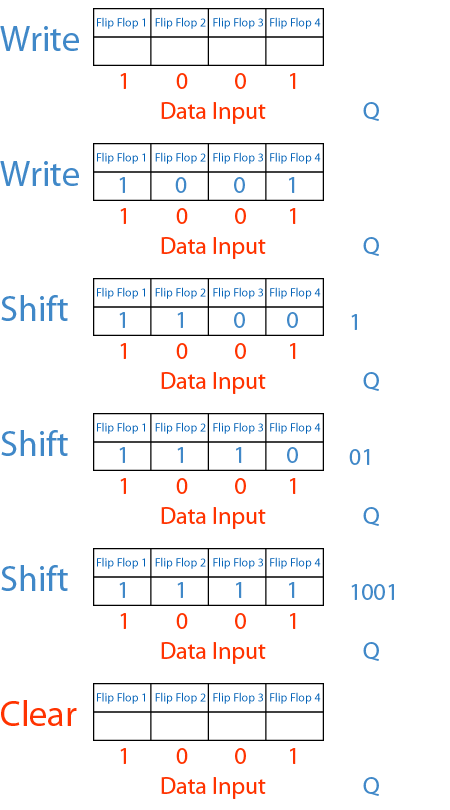
This configuration has the information input on lines D1 through D4 in parallel format, D1 existence the nearly pregnant bit. To write the data to the register, the Write/Shift control line must be held Low. To shift the data, the W/S control line is brought HIGH and the registers are clocked. The organization now acts equally a PISO shift register, with D1 as the Data Input. Notwithstanding, every bit long as the number of clock cycles is non more than the length of the data-cord, the Data Output, Q, will exist the parallel information read off in gild.
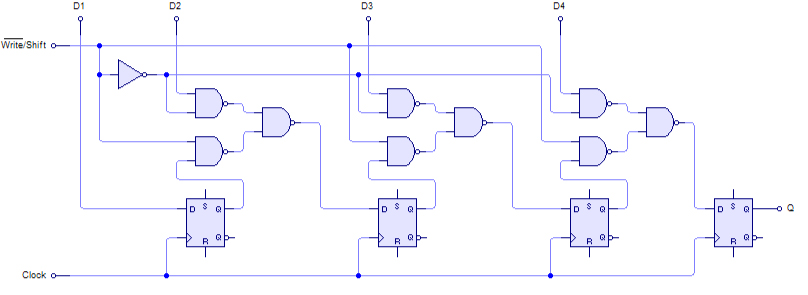
four-Bit PISO Shift Register
The blitheness below shows the write/shift sequence, including the internal state of the shift annals.
Uses [edit]

Toshiba TC4015BP – dual 4-stage static shift annals (with serial input/parallel output)
1 of the most mutual uses of a shift annals is to convert between series and parallel interfaces. This is useful equally many circuits piece of work on groups of bits in parallel, just serial interfaces are simpler to construct. Shift registers can be used as simple filibuster circuits. Several bidirectional shift registers could also be continued in parallel for a hardware implementation of a stack.
SIPO registers are commonly fastened to the output of microprocessors when more than general-purpose input/output pins are required than are available. This allows several binary devices to be controlled using just two or three pins, but more slowly than by parallel output. The devices in question are attached to the parallel outputs of the shift register, and the desired country for all those devices tin can be sent out of the microprocessor using a single serial connection. Similarly, PISO configurations are ordinarily used to add more binary inputs to a microprocessor than are available – each binary input (such equally a button or more complicated circuitry) is fastened to a parallel input of the shift annals, and then the data is sent back via serial to the microprocessor using several fewer lines than originally required.
Shift registers can also be used as pulse extenders. Compared to monostable multivibrators, the timing has no dependency on component values, however, it requires external clock, and the timing accuracy is limited by a granularity of this clock. Instance: Ronja Twister, where five 74164 shift registers create the core of the timing logic this fashion (schematic).
In early on computers, shift registers were used to handle data processing: two numbers to be added were stored in two shift registers and clocked out into an arithmetics and logic unit (ALU) with the event being fed back to the input of one of the shift registers (the accumulator), which was one bit longer, since binary addition can only effect in an respond that has the same size or is one chip longer.
Many reckoner languages include instructions to "shift right" and "shift left" the information in a register, finer dividing by ii or multiplying past 2 for each place shifted.
Very big series-in series-out shift registers (thousands of bits in size) were used in a similar way to the before delay-line memory in some devices congenital in the early 1970s. Such memories were sometimes called "circulating memory". For case, the Datapoint 3300 terminal stored its display of 25 rows of 72 columns of 6-bit upper-instance characters using 54 (bundled in 6 tracks of nine packs) 200-scrap shift registers, providing storage for 1800 characters. The shift register design meant that scrolling the final display could be accomplished past simply pausing the display output to skip one line of characters.[one]
History [edit]
One of the start known examples of a shift register was in the Mark 2 Colossus, a code-breaking machine built in 1944. It was a six-stage device built of vacuum tubes and thyratrons.[ii] A shift register was as well used in the IAS auto, built by John von Neumann and others at the Establish for Advanced Study in the belatedly 1940s.
See likewise [edit]
- Filibuster-line retentivity
- Linear-feedback shift annals (LFSR)
- Ring counter
- SerDes (Serializer/Deserializer)
- Serial Peripheral Interface Bus
- Shift register lookup table (SRL)
- Circular buffer
References [edit]
- ^ bitsavers.org, DataPoint 3300 Maintenance Manual, Dec 1976.
- ^ Flowers, Thomas H. (1983), "The Design of Colossus", Register of the History of Computing, v (iii): 246, doi:10.1109/MAHC.1983.10079

Source: https://en.wikipedia.org/wiki/Shift_register
Posted by: williamswhing1935.blogspot.com
0 Response to "How Many States In A Two Bit Register"
Post a Comment